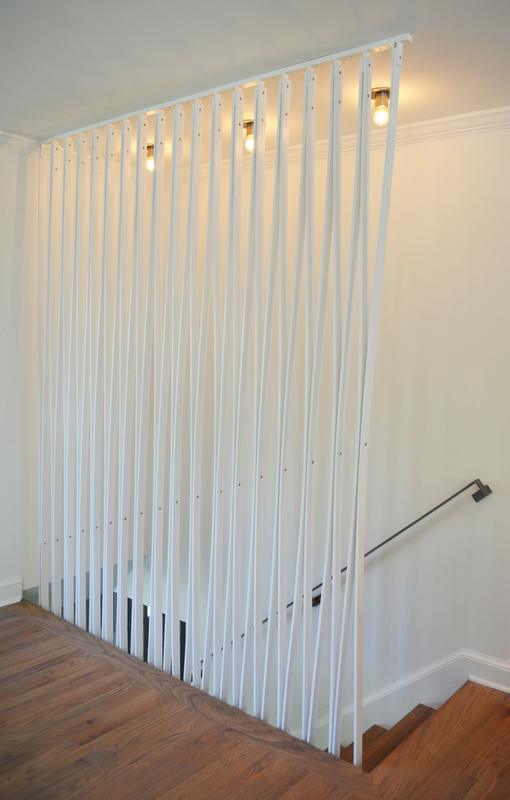
Stair screen
Thirty-six poplar strips, each pinched at its midpoint.
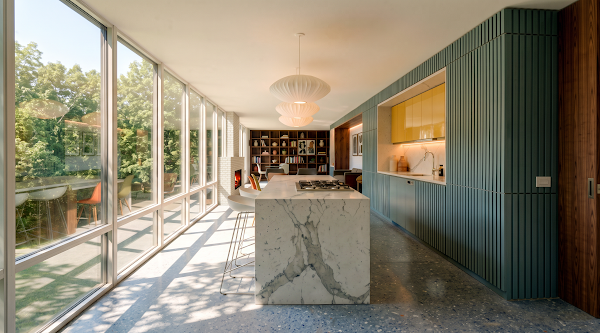
One core
One element carrying the services and setting up the circulation.
There's one thing to fix
Single-element work in DC, Maryland and Virginia. The house is fine. One thing is not.
Not every house needs a renovation. Some need one element resolved.
A stair that never worked. An entry that leaves you standing in the wrong room. A wall between two spaces that should be one opening. The rest of the house is fine, and gutting it to fix one thing would be absurd. A single element is a real commission, and it is frequently where design does the most visible work per dollar, because the whole budget goes into one move instead of being spread thin across a plan.
A stair, a screen, an entry, a fireplace wall, a built-in, a railing, an opening between two rooms. Anything the house has to live with every day and cannot buy from a catalogue.
If it can be ordered from a page, it does not need drawing. If it is one of a kind and permanent, it usually repays it.
A visit, a measured look at what is there, options, then a drawing set complete enough for a fabricator or a carpenter to build from without guessing.
Small scopes are hourly or a fixed fee for a defined deliverable. A percentage of a small construction cost does not fund the work involved, so it is not billed that way.
Concentrated scope is where craft becomes affordable. The same money that buys ordinary finishes across four rooms buys something genuinely made in one place.
And it frequently changes how the whole house reads, because the element you fixed was the one you noticed every time you walked past it.
Yes. A single element is a real commission, and it is often the one where design makes the largest visible difference relative to what it costs.
It is also the least disruptive way to work on a house. No permit in most cases, no moving out, no six months of dust.
A stair, a screen, an entry, a fireplace wall, a built-in, a railing, an opening between two rooms. Anything where the house works but one element is doing its job badly or not at all.
The test is whether fixing it requires touching the plan. If it does, it is a renovation wearing a smaller name, and it is better to say so at the start.
It depends on whether the piece is visible and whether it is custom. Something ordered from a catalogue does not need drawing. A one-off that will be seen every day, and built once, generally does.
Concentrated scope is where craft becomes affordable. The money that buys ordinary finishes across four rooms buys something genuinely made in one place.
Hourly, or a fixed fee for a defined deliverable. A percentage of construction cost does not work at this size, because a percentage of a small number does not fund the work involved.
The deliverable is a drawing set complete enough for a fabricator or carpenter to build from without guessing, which is the whole point of doing it this way.
"Fix the one thing, not everything."
Luis Boza · On single-element work
Know exactly what is bothering you?
That is usually enough to start. One element, described in a sentence, is a workable brief.
Start with one question →Turning out to be more than one thing? Whole house renovation.